THIS ISSUE'S HEADLINES
Rhode Island Updates Uniform Commercial Code to Address Digital Assets: What You Need to Know
Internal Revenue Code Sections and Considerations When Structuring an M&A Deal
Practicing Preventive Law: Seven Common Mistakes Of Closely Held Companies
How the 2024 Elections and Proposed Estate Tax Reforms Could Impact Estate Planning Strategies

RHODE ISLAND UPDATES UNIFORM COMMERCIAL CODE TO ADDRESS DIGITAL ASSETS: WHAT YOU NEED TO KNOW
 On June 10, 2024, the Rhode Island General Assembly signed into law certain amendments to Rhode Island’s Uniform Commercial Code that became effective July 1, 2024. The Uniform Commercial Code (UCC) governs commercial transactions and has been adopted in every U.S. jurisdiction in nearly identical form. The UCC is periodically updated to reflect legal and technological developments. This year’s amendments are a response to market concerns about the lack of definitive commercial law rules for transactions involving digital assets, especially relating to (a) negotiability for virtual currencies, (b) certain electronic payment rights, (c) secured lending against virtual currencies, and (d) security interests in electronic money. On June 10, 2024, the Rhode Island General Assembly signed into law certain amendments to Rhode Island’s Uniform Commercial Code that became effective July 1, 2024. The Uniform Commercial Code (UCC) governs commercial transactions and has been adopted in every U.S. jurisdiction in nearly identical form. The UCC is periodically updated to reflect legal and technological developments. This year’s amendments are a response to market concerns about the lack of definitive commercial law rules for transactions involving digital assets, especially relating to (a) negotiability for virtual currencies, (b) certain electronic payment rights, (c) secured lending against virtual currencies, and (d) security interests in electronic money.
RI’s Uniform Commercial Code provisions have been updated to implement the following:
- Creating a new UCC Article 12 on Controllable Electronic Records (“CERs”). CERs are a newly classified category of property that includes assets stored on a blockchain. The new amendments make CERs negotiable in the same manner as cash or checks. See Laws Section 6A-12-101- 107;
- Updating Article 9 to allow perfection of security interests in digital assets. See R.I. Gen. Laws Section 6A-9-105.1 and R.I. Gen. Laws Section 6A-9-312;
- Making new rules for mix transactions involving both goods and services;
- Updating rules for electronic negotiable instruments; and
• Updating terminology to account for electronic signatures and documents.
If you have any questions pertaining to the Uniform Commercial Code and Secured Transactions, please contact Attorney Amanda Perry Lepre at 401-824-5100 or aperry@pldolaw.com. For further information on the Uniform Commercial Code’s adoption in other jurisdictions, click here.
[back to top]
INTERNAL REVENUE CODE SECTIONS AND CONSIDERATIONS WHEN STRUCTURING AN M&A DEAL
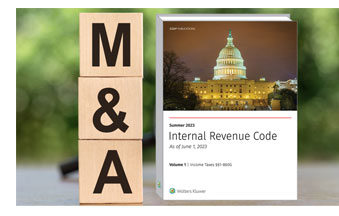 Generally speaking, when a business is sold either all of its assets are sold to the buyer, or the ownership interests are purchased by the buyer. Typically, in an M&A Transaction buyers will seek to structure the deal as an asset purchase as opposed to an equity interest purchase to avoid exposure to entity level liabilities. However, in a world where the regulatory process has become increasingly complex, costly and time consuming, some buyers are opting to purchase equity interests. For example, when the target company has a license or federal approval already in place, a buyer may find it more cost efficient to acquire the existing company and seek approval of the ownership interest transfer, if necessary, rather than start the license or application process from scratch. Generally speaking, when a business is sold either all of its assets are sold to the buyer, or the ownership interests are purchased by the buyer. Typically, in an M&A Transaction buyers will seek to structure the deal as an asset purchase as opposed to an equity interest purchase to avoid exposure to entity level liabilities. However, in a world where the regulatory process has become increasingly complex, costly and time consuming, some buyers are opting to purchase equity interests. For example, when the target company has a license or federal approval already in place, a buyer may find it more cost efficient to acquire the existing company and seek approval of the ownership interest transfer, if necessary, rather than start the license or application process from scratch.
When negotiating and structuring an M&A transaction as an entity purchase, it is important to consider Internal Revenue Code (IRC) Sections 336 and 338 to avoid losing valuable tax benefits for the buyer and the seller. If an IRC Section 336(e) or 338(h)(10) election is made a buyer can acquire the entity interests in the target company and still receive a step-up in basis to fair market value for the target’s underlying assets. This can lead to valuable tax benefits in the form of future depreciation or amortization for the buyer. Utilizing these elections would allow the transaction to be treated as a sale of the target’s assets for tax purposes but not for legal purposes.
There are a few key comparisons between Section 336(e) and Section 338(h)(10) that should be considered when determining which election to make:
- A 336(e) election can provide a seller relief from multiple levels of tax on the same economic gain when the target is a corporate subsidiary.
- A 338(h)(10) election requires the purchaser to be a corporation. With a 336(e) election, the buyer can be an LLC that is disregarded for tax purposes.
- A 338(h)(10) election generally requires a single purchasing corporation to acquire the target stock.
- A 338(h)(10) election requires the buyer and seller to jointly agree to the election while a 336(e) election is made by the seller and does not require the buyer’s consent.
Ultimately, deciding whether to apply Section 336(e) or 338(h)(10) depends on the deal’s goals, the tax profiles of the buyer and seller, and whether the transaction involves liquidation or continuation of the target entity. For further guidance navigating these Sections and the tax implications of M&A transactions please contact Attorney Gene M. Carlino or Attorney Katherine B. Dunn at 401-824-5100.
[back to top]
PRACTICING PREVENTIVE LAW: SEVEN COMMON MISTAKES OF CLOSELY HELD COMPANIES
 Preventive law is a legal practice that aims to reduce the risk of litigation and its adverse (and costly) consequences. Similar at its core to preventive medicine, its purpose in the business realm is to proactively implement strategies that help prevent legal problems before they arise. PLDO Partner William F. Miller discusses the most frequently overlooked issues by private companies in his latest Client Advisory, which can be accessed by clicking here. Preventive law is a legal practice that aims to reduce the risk of litigation and its adverse (and costly) consequences. Similar at its core to preventive medicine, its purpose in the business realm is to proactively implement strategies that help prevent legal problems before they arise. PLDO Partner William F. Miller discusses the most frequently overlooked issues by private companies in his latest Client Advisory, which can be accessed by clicking here.
By practicing preventative law and addressing these issues before they become problems, closely held businesses can more effectively manage legal risks and costs. If you have questions or would like more information, please contact PLDO Partner William F. Miller at 508-420-7159 or email wmiller@pldolaw.com.
[back to top]
HOW THE 2024 ELECTIONS AND PROPOSED ESTATE TAX REFORMS COULD IMPACT ESTATE PLANNING STRATEGIES
 The American Housing and Economic Mobility Act of 2024, which is supported by presidential candidate Kamala Harris, represents a dramatic shift from current tax policies. Read PLDO Partner Gene M. Carlino's Advisory, How the 2024 Elections and Proposed Estate Tax Reforms Could Impact Estate Planning Strategies, for an in-depth analysis on the proposed federal estate tax reforms that could significantly impact high-net-worth individuals’ and families’ estate planning, charitable giving and financial strategies in 2025, and beyond. To access the Advisory, click here. If you have questions or need assistance, please contact Attorney Carlino at (401) 824-5138 | gmcarlino@pldolaw.com; Bernard A. Jackvony at (401) 824-5185 | bjackvony@pldolaw.com or Leah A. Foertsch at 561-362-2030 | lfoertsch@pldolaw.com. The American Housing and Economic Mobility Act of 2024, which is supported by presidential candidate Kamala Harris, represents a dramatic shift from current tax policies. Read PLDO Partner Gene M. Carlino's Advisory, How the 2024 Elections and Proposed Estate Tax Reforms Could Impact Estate Planning Strategies, for an in-depth analysis on the proposed federal estate tax reforms that could significantly impact high-net-worth individuals’ and families’ estate planning, charitable giving and financial strategies in 2025, and beyond. To access the Advisory, click here. If you have questions or need assistance, please contact Attorney Carlino at (401) 824-5138 | gmcarlino@pldolaw.com; Bernard A. Jackvony at (401) 824-5185 | bjackvony@pldolaw.com or Leah A. Foertsch at 561-362-2030 | lfoertsch@pldolaw.com.
[back to top]
|